
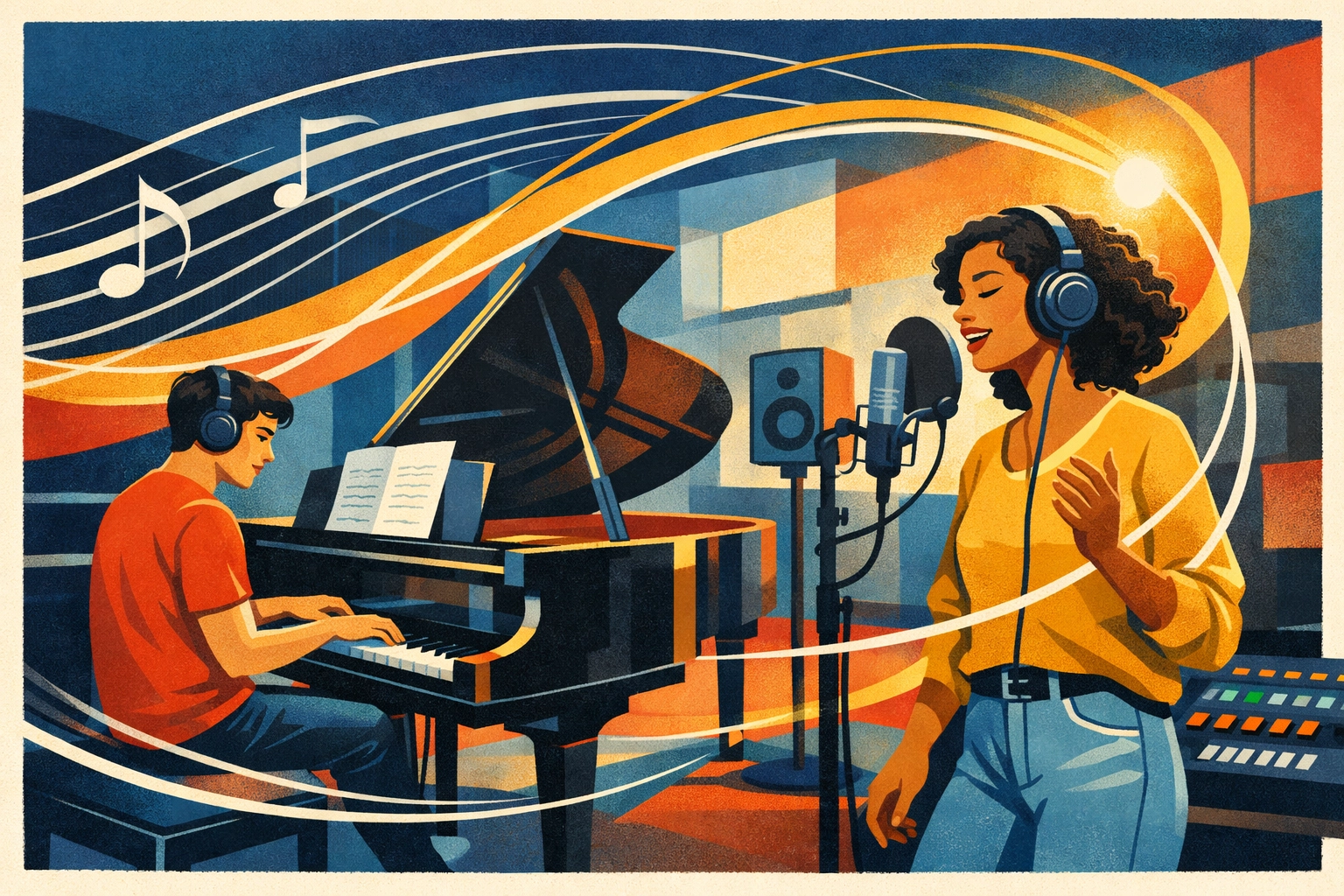
When you listen to a truly great piece of music: whether it’s a thundering Rachmaninoff concerto or a soul-stirring vocal ballad: you aren't just hearing a series of frequencies and rhythms. You are experiencing a journey. You are hearing a story.
At AM Music Academy, we talk a lot about "artisan education." This means we move past the mechanics of which finger goes on which key and dive deep into the why of the music. One of the most transformative concepts I work on with my students is the idea of the musical narrative arc.
Music, much like a classic novel or a Hollywood blockbuster, follows a traditional storyline. It has an introduction, a rising action, a heart-stopping climax, and a resolution. Understanding this structure is what separates a "student" from a "musician." Whether you are looking into piano lessons for kids or starting voice lessons for beginners, mastering the "Golden Arc" is the secret to moving an audience.
The Anatomy of a Musical Narrative
Every great story follows a shape. If you were to map out the tension in a story, it wouldn't be a flat line. It would look like a mountain range. There is an exposition where the characters (the themes) are introduced, a series of smaller hills (the development), a peak (the climax), and a descent back to the valley (the resolution).
In music, we call this "phrasing" and "structure." Without it, music is just noise. Imagine someone reading a book in a complete monotone, ignoring all periods, commas, and exclamation points. You’d lose interest in seconds. Sadly, many students play this way: hitting every note with the same intensity.
Our job as mentors is to help students find the "breath" in the music. We look for the "rising action": those moments where the harmony gets a little more tense, the volume grows (crescendo), and the tempo might push forward slightly. Then, we find the "falling action," where the tension releases and the music "breathes" out.

The Magic of the Golden Ratio
Have you ever noticed that the most exciting part of a song usually happens about two-thirds of the way through? That isn’t a coincidence. It’s math: specifically, the Golden Ratio (phi, or approximately 1.618).
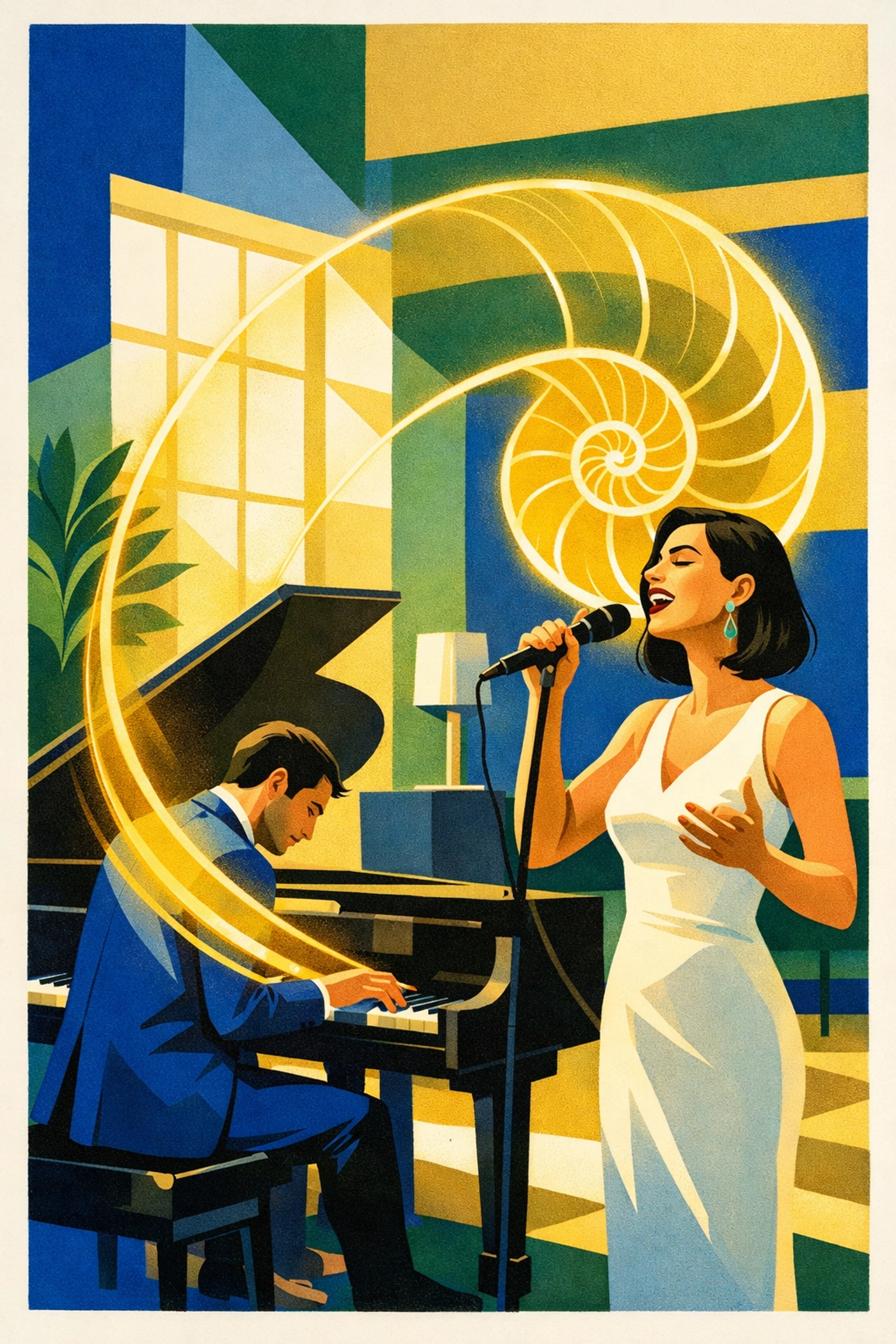
Nature loves the Golden Ratio. You find it in the spiral of a seashell, the petals of a flower, and the proportions of the human body. Composers, either consciously or instinctively, have used this ratio for centuries. They know that the human brain finds the most satisfaction when the "peak" of a piece occurs right around the 61.8% mark of the total duration.
When I sit down with my students, we often take a pencil to their sheet music and literally mark the "Golden Peak."
- Is it a high C in a vocal aria?
- Is it a crashing fortissimo chord in a piano sonata?
- Is it a moment of sudden, profound silence?
Identifying this peak changes everything. Once a student knows where they are going, every note before that point becomes a strategic step toward the summit. This kind of high-level thinking is exactly why music lessons build the grit and focus needed for real-world success.
Scaling the Smaller Peaks
You don't just teleport to the top of Mount Everest. You have to climb the smaller ridges first. Music works the same way. A five-minute piece might have one "Main Climax," but it will have a dozen "mini-climaxes" along the way.
We teach our students to treat these smaller peaks like chapters in a book. Each phrase has its own tiny arc. If you play every "mini-peak" at maximum volume, you have nowhere left to go when you reach the actual climax. It’s about the economy of energy.
This is a vital lesson in piano lessons for kids. Younger students often want to play everything "fast and loud" because it feels exciting. We mentor them to understand that the quiet moments are what make the loud moments powerful. By learning to control these smaller peaks, they develop incredible discipline and emotional intelligence.
Telling the Story Through the Keys
For our piano students, storytelling is a physical act. Since a piano can’t "speak" words, the story is told through touch (articulation) and volume (dynamics).
When we work on a piece, we might assign "characters" to different melodies. Maybe the left hand is a grumbling giant and the right hand is a fluttering bird. How do they interact? When the bird reaches the Golden Ratio peak, is it escaping the giant, or is it soaring over a mountain?
By giving the music a narrative, the student stops worrying about "wrong notes" and starts worrying about "the story." Ironically, when you focus on the story, the technical mistakes usually disappear because your brain is focused on the big picture. This is a core part of our Artisan Music Education philosophy: we don't just teach the instrument; we teach the art.
Telling the Story Through the Voice
In voice lessons for beginners, the storytelling is even more literal because we have lyrics. However, the trap many singers fall into is relying only on the words.
A great singer can move an audience even if they are singing in a language the audience doesn't understand. Why? Because they are following the Golden Arc. They use their breath to build tension. They use "vocal color": changing the texture of their voice from breathy to bright: to signal different parts of the story.
I often tell my voice students that the "breath" is the engine of the narrative. If you take a shallow, panicked breath before the climax, the audience feels that panic. If you take a deep, grounded, intentional breath, the audience feels the power of the coming peak. We work on turning choir dreams into reality by focusing on this narrative control.
Why This Matters for Your Kid’s Future
You might wonder, "Does it really matter if my child knows about the Golden Ratio in a piano piece?"
The answer is a resounding yes. When a child learns to identify a narrative arc, they are learning structural thinking. They are learning how to analyze a complex system, identify the most important parts, and manage their resources to reach a goal. These are the same skills used by CEOs, engineers, and storytellers in every field.
It’s about more than just music; it’s a brain hack. We’ve discussed before how piano lessons are a game-changer for a kid’s future, and this narrative training is a huge part of that. It builds empathy, as students have to "feel" the emotions of the composer, and it builds patience, as they learn that the "best part" of the song (the climax) must be earned through the rising action.
The AM Music Academy Approach
At AM Music Academy, we don't believe in a one-size-fits-all curriculum. Every student has a different "story" to tell. Whether you’re an adult looking for a creative outlet or a parent looking for high-quality instruction for your child, we tailor our approach to you.
We understand that muscle memory isn't enough. To truly excel, you need to understand the architecture of the music. That’s why our instructors, like Angela Fisher, focus on mentorship over mere "tutoring."
We invite you to join our community and discover the "Golden Arc" in your own playing or singing. Whether you choose in-person lessons or our deep-mastery online options, we are here to support your journey.
Summary of the Storytelling Arc:
- The Introduction (Exposition): Setting the mood and introducing the main "characters" (melodies).
- The Rising Action: Building tension through dynamics, harmony, and smaller peaks.
- The Climax (The Golden Ratio): The emotional heart of the piece, occurring roughly 2/3rds of the way through.
- The Falling Action: Releasing the tension and moving toward the end.
- The Resolution: Providing the listener with a sense of "home" and closure.
Music is the art of telling a story without saying a word. It’s a universal language, and we can’t wait to help you speak it fluently.
If you're ready to start your own musical narrative, contact us today or meet our team to find the perfect mentor for your journey. Let's find your Golden Arc together.
Leave a Reply
You must be logged in to post a comment.