
It’s a scene every pianist knows all too well. You’re on stage at a local competition here in Florissant, the lights are bright, and your heart is racing. You’ve practiced your piece hundreds of times. Your fingers know exactly where to go. You hit "play" in your brain, and your hands take over.
But then, it happens. A bead of sweat makes a finger slip. Or perhaps a sudden cough from the audience breaks your concentration for a split second. Suddenly, the "auto-pilot" disconnects. You look down at the keys, and they look like a foreign language. Your hands are frozen. You know the music is still in there somewhere, but because you were relying entirely on muscle memory, you’ve lost your place on the map.
As we head deep into contest season for our students in the St. Louis area, this "Memory Trap" is something we talk about a lot at AM Music Academy. While muscle memory is a vital tool, it is also a fragile one. To truly master a performance, you need more than just "fast fingers": you need a roadmap built on music theory.
The Fragility of the "Auto-Pilot"
Most students beginning piano lessons for kids start by building muscle memory. It feels like magic; after enough repetition, the piece seems to play itself. This is technically known as procedural memory. It’s the same type of memory that helps you ride a bike or tie your shoes.
However, procedural memory is linear. It functions like a cassette tape: if you want to hear a specific song, you usually have to start from the beginning or guess where to fast-forward. If the tape snaps in the middle, the whole system fails.
Research shows that muscle memory is incredibly sensitive to environment. A famous study found that students who practiced on one piano but performed on another saw their scores drop by nearly 50%. Why? Because the touch of the keys was different, the height of the bench was off, or the acoustics of the room changed the sensory feedback. When you rely only on your hands, any small change in the "feel" of the performance can lead to a total blackout.

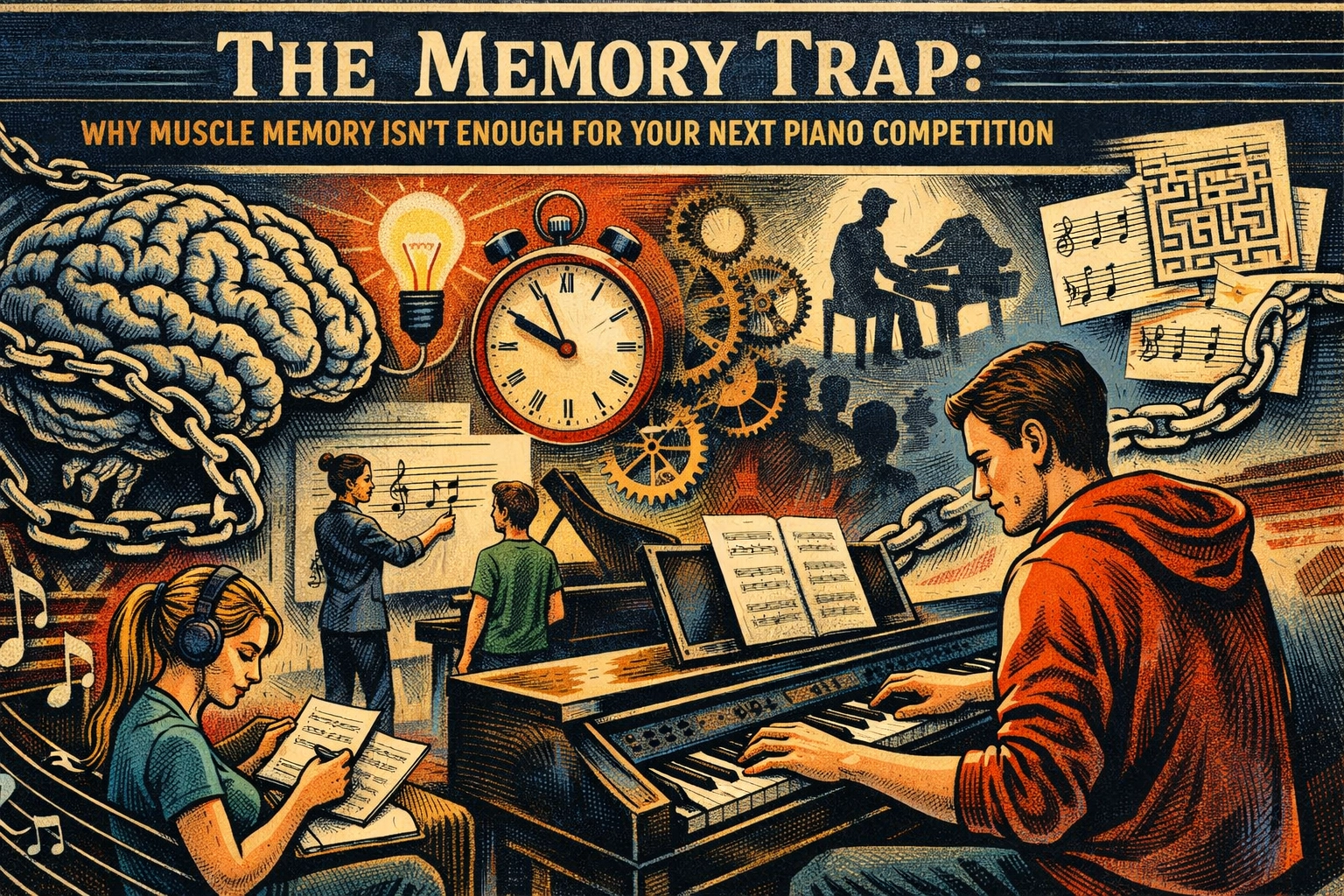
A modern lithograph-style illustration of a student in a contemporary hoodie sitting at a sleek grand piano, looking intensely focused as abstract musical structures float around them.
The Interdependency Problem
Another reason muscle memory fails is what experts call "interdependency." When you learn a piece, your brain often links the left and right hands together as a single unit of action. If your left hand flubs a chord, your right hand often stops too because it doesn't know how to function independently of that specific left-hand cue.
This is where many students get "stranded." They can't find a way back into the music because they don't actually know where they are in the story of the piece; they only know the physical sequence of movements.
Minds, Hands, and Hearts: The Artisan Framework
At AM Music Academy, we don't just teach you how to hit the right notes. We practice an "artisan education" model, which means we look at the whole artist. We use a framework we call Hands, Minds, and Hearts.
- The Hands (Technique): This is the physical ability to execute the music.
- The Minds (Theory): This is the intellectual understanding of the music’s structure.
- The Hearts (Expression): This is the emotional connection and storytelling.
While many standard piano lessons in Florissant, Missouri focus almost entirely on the "Hands," we believe the "Minds" provide the safety net. When you understand the music theory behind your piece, you aren't just memorizing a sequence of finger movements; you are memorizing a structural map.
How Music Theory Becomes Your Performance GPS
Imagine driving through a city. If you only memorize "turn left at the red house, then right at the big tree," you’ll get lost the moment the house is repainted or the tree is cut down. But if you have a map and understand that you are heading North on 5th Street toward the downtown corridor, you can always find your way back.
Music theory is that map. When a student understands that a specific section of their competition piece is a "Circle of Fifths" progression or that they are transitioning from the tonic to the dominant key, they gain "intellectual landmarks."
If a finger slips during a sonata, a student trained in theory doesn't panic. They think, "I'm in G major, and I'm headed toward the cadence." They can visualize the chord shapes and harmonic patterns. Even if the "auto-pilot" skips a beat, the "Mind" knows exactly where the music is going next. This ability to recover is what separates a good student from a master performer.

A vibrant, modern lithograph showing a close-up of a pianist's hands on the keys, with glowing geometric shapes and chord symbols rising from the piano, representing the mental map of music theory.
Building the "Recovery Map"
So, how do we move beyond muscle memory? It starts with custom, one-on-one mentorship. Whether you are taking music theory lessons online or in-person at our studio, we help you deconstruct your music.
- Harmonic Analysis: We look at the "skeleton" of the piece. What chords are being used? Why did the composer choose this specific progression?
- Structural Awareness: We identify sections (A-B-A form, for example). Knowing you are at the start of the "B" section gives you a mental "restart point" if things go wrong.
- Mental Rehearsal: We encourage students to "play" the piece in their heads away from the piano. If you can’t visualize the notes without your fingers moving, you don’t fully know the piece yet.
This level of detail is a hallmark of artisan music education. It’s not about finishing a book; it’s about deep mastery.
Supporting Our Florissant Competitors
Right now, our halls are filled with the sounds of competition prep. We see the hard work our students are putting in, and we know the pressure of performing for judges. It’s why we emphasize this intellectual approach so heavily during contest season. We want our students to walk onto that stage feeling bulletproof.
When your "Minds" support your "Hands," the "Hearts" can finally take over. You stop worrying about "what comes next" and start focusing on "how does this feel?" True artistry happens when the technical and intellectual work is so solid that the performer is free to simply be expressive.
https://cdn.marblism.com/gsLRjqhhLlx.jpg
Angela Fisher working with a student, illustrating the supportive, one-on-one mentorship that helps students bridge the gap between technique and understanding.

The Competency Edge
Building this kind of memory takes more effort than simple repetition. It requires focus, grit, and a willingness to look under the hood of the music. But the rewards go far beyond a trophy at a piano competition.
The ability to analyze a complex system (like a musical score), identify its patterns, and create a multi-layered memory strategy is a skill that translates to every part of life. Whether it’s preparing for a high-stakes presentation or studying for an exam, the "Minds" approach we teach at AM Music Academy builds a level of focus that stays with a student forever. You can read more about this in our post on The Competency Edge.

A modern lithograph of a student performing in a contemporary recital hall. The style is colorful and stylized, capturing the energy and confidence of a well-prepared performer.
Final Thoughts for Contest Season
To all our students heading out to competitions this month: remember that your fingers are just the messengers. Your brain is the conductor. If you find yourself hitting a wall with your memorization, take a step back from the keys. Look at your score. Analyze the patterns. Find your landmarks.
If you’re a parent in Florissant or the greater St. Louis area looking for a music program that goes deeper than just "playing the songs," we’d love to meet you. Whether you’re looking for private piano lessons or want to bolster your skills with music theory lessons online, our artisan instructors are here to help you build a musical foundation that will never leave you stranded.
Good luck to everyone competing! We are so proud of the work you’re doing. Let’s make this the most confident contest season yet.
Interested in learning more about our unique approach? Meet our team and see how we tailor every lesson plan to the individual student on our About Us page.
Leave a Reply
You must be logged in to post a comment.