
When you walk into a private music school in St. Louis, you expect to see the heavy hitters: the grand pianos, the professional-grade microphones, the sprawling stacks of sheet music. But if you look closer at the workstations of our most successful students and faculty here at AM Music Academy, you’ll find a much smaller, humbler tool that actually does more heavy lifting than the instrument itself.
I’m talking about the pencil.
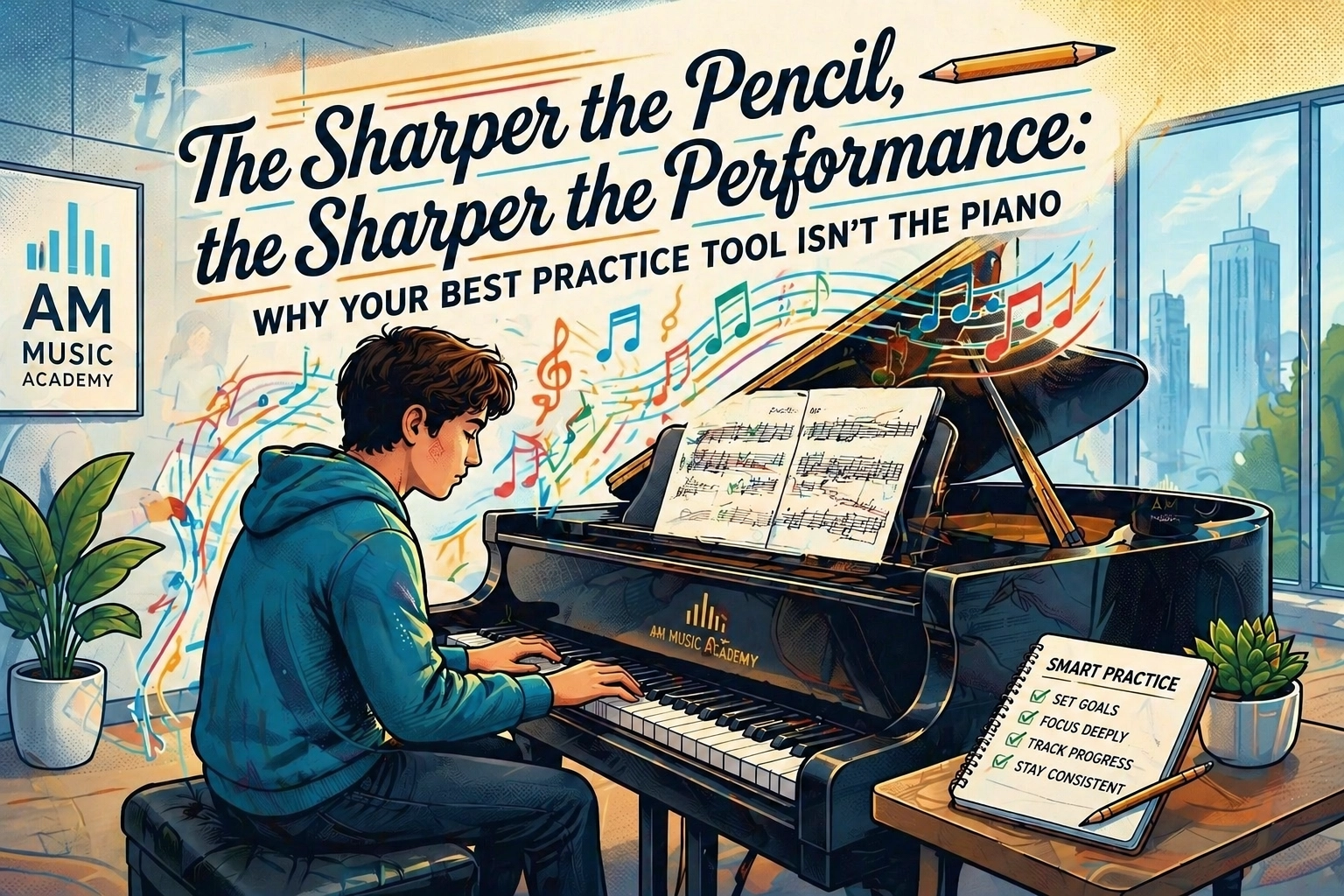
A few years ago, I ran a series of lessons with my students focused on the "Art of the Environment." We weren’t looking at notes or rhythms; we were looking at how they actually sat down to work at home. We mapped out the perfect lighting to reduce eye strain, discussed the best time of day for their specific energy levels, and ensured their practice notes were always within eye line. We talked about having water, a metronome, and a comfortable chair all at arm's reach.
But the cornerstone of that entire series: the one thing that separated the students who plateaued from the ones who soared: was the quick and easy access to a pencil.
The "Pencil Quiz" and the Readiness Mindset
To drive the point home, I started "quizzing" my students. In the middle of a particularly tricky passage during a lesson, I would stop them and say, "Grab your pencil."
The catch? They weren't allowed to move from their chair.
If they had to stand up, walk across the room to a junk drawer, or dig through a backpack, they failed the quiz. It sounds like a small thing, but that friction: that ten-second gap between identifying a problem and marking a solution: is where musical progress goes to die. In our piano lessons for kids, we teach that the pencil isn't just for corrections; it’s a physical extension of the musical mind. If you have to break your "flow state" to find a writing utensil, you’ve already lost the mental thread of the performance.

The Professional Standard: It’s Not Just for Beginners
Sometimes, intermediate students think it’s "extra cool" not to write things down. There’s a certain bravado in saying, "I’ll just remember it." They view marks on a page as a sign of weakness or a lack of talent.
In reality, the exact opposite is true.
I spend a lot of my time singing with a professional choir. If you were to peek over the shoulders of these world-class vocalists during a rehearsal, you would see a sea of grey graphite. Every single one of them has a pencil in hand. We are constantly marking breaths, vowel shapes, and subtle shifts in dynamics. At that level, we know that the human brain is designed for creativity and artistry, not for acting as a storage locker for a thousand tiny technical reminders.
Whether you are looking for a singing coach near me or tackling advanced Chopin, the pro move is always to write it down. The faster a student realizes that the "best" musicians are the ones with the most marked-up scores, the faster they begin to see real results in their own playing.
The Pregnancy Brain Epiphany
My obsession with the pencil reached a fever pitch a few years ago when I was pregnant with my daughter. For anyone who hasn't experienced "pregnancy brain," it’s a very real phenomenon where your short-term memory feels like it’s been replaced by a sieve.
During that time, I was still performing and teaching, but I couldn't trust my brain to remember a correction from five minutes ago, let alone from the previous day’s practice session. Out of sheer necessity, I started "over-marking" my music. I developed a system where I marked absolutely everything: every hesitation, every finger change, every subtle cue.
I expected it to be a temporary crutch. Instead, it was a revelation.
Because I was offloading the "data" of the music onto the paper, my brain was finally free to actually make music. I wasn't worried about "remembering" the F-sharp in measure 42 because the pencil had already handled that. I could focus on the tone, the emotion, and the storytelling. The results were so profound that I’ve never gone back. Today, I teach this same artisan approach to every student at AM Music Academy, ensuring their customized plan includes mastery over their own notation.

The Two Golden Rules of Marking
To make the pencil an effective tool rather than just a source of clutter, I give my students two specific rules to live by.
1. The Twice Rule
If you make the same mistake twice, you must mark it. No exceptions. Making a mistake once is an accident; making it twice is a pattern. If you don't mark it after the second time, you are effectively practicing the mistake. You are teaching your nervous system to do it wrong. A quick circle or a finger number breaks that cycle immediately.
2. The Hesitation Rule
This is the "pro-level" rule I hold myself to. You should mark your music any time there is even a hint of a question or a split-second of hesitation. If you find yourself pausing: even for a millisecond: to remember which finger comes next or whether that note is a B-flat, the music isn't settled. That hesitation will turn into a full-blown error under the pressure of a performance or competition. By marking the point of hesitation, you provide your brain with a "safety rail" that guides you through the moment without a hitch.

Cognitive Offloading: Let the Paper Hold the Weight
There is a scientific concept at play here called "cognitive offloading." Our brains have a limited amount of "working memory." When you are trying to perform a complex piece of music, your brain is juggling rhythm, pitch, physical technique, emotional expression, and room acoustics all at once.
If you force your brain to also use its limited energy to "remember" a specific correction you made last Tuesday, you are stealing resources away from your artistry.
When you use a pencil, you are effectively "saving your progress" to an external hard drive (the sheet music). This allows your brain to focus entirely on the "Artisan Education" we value so much: the deep mastery of the craft. This is especially vital for students taking piano lessons in Florissant, Missouri, where we focus on building high-level competency that lasts a lifetime.
The Language of Symbols: Specificity is Key
One final tip for your practice: a circle is not a mark.
Many students will simply circle a measure where they struggled. But a circle doesn't tell you what went wrong. It just tells you that you were unhappy in that general vicinity. It’s like a map that just says "Warning: Dragons" without telling you how to slay them.
Your markings need to be specific.
- Don't circle the note; write the finger number you keep forgetting.
- Don't circle the rhythm; write in the subdivision or the "and" where the beat falls.
- Don't circle the dynamic; write a literal reminder to "Relax" or "Prepare Thumb."
The goal is to provide your future self with the exact instruction needed to succeed in that moment.

Are You Ready to Sharpen Your Performance?
At AM Music Academy, we believe that the best music education happens at the intersection of high-level technique and practical, real-world habits. Whether you're looking for private music instruction for your child or you’re an adult looking to reclaim your musical voice, we provide a supportive, one-on-one environment tailored to your unique goals.
The next time you sit down to play, make sure there’s a sharp pencil within reach. It might just be the most important "instrument" in the room.
If you’re ready to take your practice to the next level with a mentor who understands the nuances of the craft, contact us today to join our community of artisans. Let’s make something beautiful together: and don't worry, we’ve got plenty of pencils waiting for you.
Leave a Reply
You must be logged in to post a comment.